Reverse Crunch: Complete Guide to Form, Benefits, and Progressions

Co-Founder of Cora (YC W24). Cornell University, Economics. Based in San Francisco.
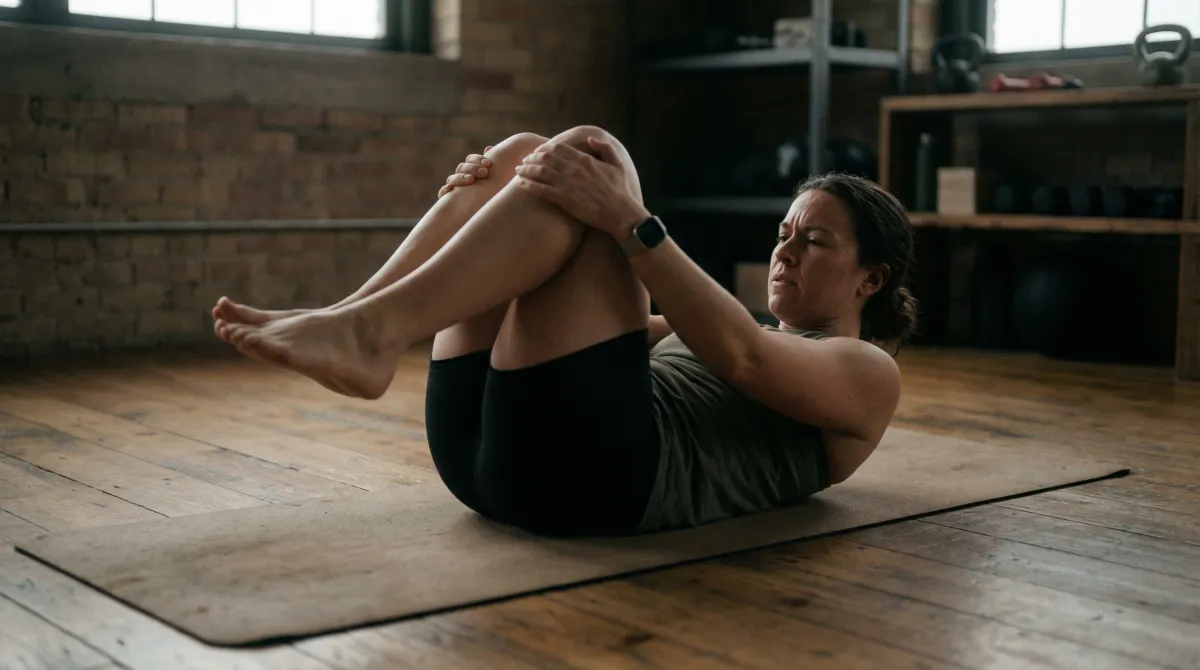
The reverse crunch is a core exercise that targets the lower abs by curling the pelvis toward the ribcage rather than the ribcage toward the pelvis. It produces high lower abdominal activation with minimal hip flexor involvement and low spinal compression, making it one of the safest and most effective ab exercises for all levels. This guide covers proper form, the most common mistakes that prevent people from feeling their abs, programming recommendations, and progressions from beginner to advanced.
If you have ever done 50 crunches and only felt them in your neck and hip flexors, the reverse crunch is the fix. By reversing the direction of spinal flexion, curling from the bottom up instead of the top down, the reverse crunch shifts the emphasis to the lower portion of the rectus abdominis. It is also significantly safer for the spine than sit-ups because the range of motion is smaller and the lumbar spine stays in a neutral or slightly flexed position throughout.
Pair this exercise with flutter kicks for anti-extension endurance and planks for isometric stability to build a well-rounded core. Browse our exercise library for more ab exercise options.
How to do a reverse crunch with proper form
- Lie on your back on a mat with your arms at your sides, palms pressing into the floor. For more stability, you can grip the edges of a bench or hold a fixed object behind your head.
- Lift your legs so your hips and knees are both at 90 degrees. Your thighs should be vertical and your shins horizontal. This is the starting position.
- Contract your abs to curl your pelvis off the floor. Think about bringing your hip bones toward your lower ribs, not your knees toward your face. Your knees will move toward your chest as a result of the pelvic curl, but the intent should be on lifting your tailbone and lower back off the mat.
- Pause for 1 to 2 seconds at the top when your hips are fully curled and your lower back has lifted off the floor. You should feel a strong contraction in your lower abs.
- Lower slowly. Take 2 to 3 seconds to uncurl back to the starting position. Do not let your legs drop or swing. Control the descent completely. Your lower back should touch the floor gently, and your hips and knees should return to the 90-90 starting position.
Muscles worked
| Muscle | Role | Engagement Level |
|---|---|---|
| Rectus abdominis (lower portion) | Curls the pelvis toward the ribcage | Primary |
| Transverse abdominis | Deep stabilization during the curl | Primary |
| Obliques (internal and external) | Assist pelvic tilt and prevent lateral deviation | Secondary |
| Hip flexors (iliopsoas) | Minimal involvement when form is correct | Secondary |
The key advantage of the reverse crunch over exercises like leg raises and flutter kicks is the reduced hip flexor involvement. Because the knees stay bent and the movement is driven by pelvic curling rather than leg lifting, the rectus abdominis does proportionally more of the work. This is why physical therapists frequently recommend reverse crunches for people who feel their hip flexors burning during other ab exercises.
Common mistakes that kill your results
- Using momentum instead of muscle. The most common mistake is swinging the legs up and using the bounce to complete reps. This turns the exercise into a hip flexor movement and removes nearly all ab engagement. Fix: Slow down every rep. Take 2 seconds to curl up, pause 1 to 2 seconds at the top, take 2 to 3 seconds to lower. If you cannot complete 8 reps at this tempo, reduce to fewer reps rather than speeding up.
- Moving your knees without curling your pelvis. Many people bring their knees toward their chest without actually lifting their hips off the floor. The knees move, but the pelvis stays flat. This is essentially a hip flexor exercise, not a reverse crunch. Fix: Focus on lifting your tailbone toward the ceiling. Your lower back should visibly peel off the mat during each rep.
- Extending your legs as you curl. Straightening your legs during the upward phase increases the moment arm and shifts load to the hip flexors. Fix: Maintain the 90-degree knee bend throughout the entire movement. Your shin-to-thigh angle should not change.
- Pressing too hard with your arms. Over-relying on your arms to push your hips up defeats the purpose. Your arms should provide light stability, not power the movement. Fix: Use only fingertip pressure on the floor, or cross your arms over your chest to remove the temptation entirely.
Reverse crunch progressions
Want Cora to help with this?
Try Cora Free Text CoraProgress through these variations as you get stronger. Only move to the next level when you can complete 3 sets of 15 reps with a 2-second pause at the top and full control on the lowering phase.
| Level | Variation | What Makes It Harder |
|---|---|---|
| Beginner | Standard reverse crunch (knees at 90 degrees) | Baseline movement |
| Intermediate | Slow eccentric reverse crunch (4-second lowering) | Increased time under tension on the negative |
| Intermediate | Decline bench reverse crunch | Gravity works against you through a larger range of motion |
| Advanced | Banded reverse crunch (mini band around feet) | Added resistance throughout the range of motion |
| Advanced | Hanging reverse crunch (from pull-up bar) | Full bodyweight load, grip challenge, greater range of motion |
How to program reverse crunches
Reverse crunches work well in three contexts:
- As a core warm-up (2 sets of 10-12). Performing reverse crunches before squats or deadlifts activates the deep core and prepares the pelvis for heavy loading. Use a controlled tempo and focus on the mind-muscle connection.
- As a core finisher (3 sets of 12-15). Place them at the end of your workout with 45 to 60 seconds rest between sets. Pair with a plank or pallof press for a complete core finisher that covers flexion, anti-extension, and anti-rotation.
- In a core circuit (30 seconds each). Combine reverse crunches with flutter kicks, bicycle crunches, and dead bugs. Perform 30 seconds of each exercise back-to-back, rest 60 seconds, and repeat 3 to 4 rounds. This gives you balanced coverage of upper abs, lower abs, obliques, and deep stabilizers.
For recovery-aware programming, Cora automatically adjusts your core volume based on your daily Body Charge score. On high-recovery days, you might see more challenging variations and higher volume. On lower-recovery days, the AI reduces intensity to protect your ability to recover for the next session. Check your readiness with the recovery calculator.
Reverse crunches vs other lower ab exercises
Want Cora to help with this?
Try Cora Free Text Cora| Exercise | Lower Ab Focus | Hip Flexor Load | Spinal Safety | Best For |
|---|---|---|---|---|
| Reverse crunch | Excellent | Low | High | Isolation, strength |
| Flutter kicks | Good | Moderate | Moderate | Endurance, cardio |
| Hanging leg raises | Excellent | High | Moderate | Advanced strength |
| Sit-ups | Moderate | High | Low | Upper abs, not recommended for lower ab focus |
The reverse crunch consistently ranks among the best exercises for lower abdominal activation with the least spinal compression. For beginners or anyone with a history of lower back discomfort, it is typically the safest starting point for lower ab training.
Key Takeaways
- Reverse crunches target the lower abs by curling the pelvis toward the ribcage, the opposite direction of a standard crunch.
- The most important cue: lift your tailbone off the floor, not just your knees toward your chest. If your hips stay flat, your abs are not doing the work.
- Use a slow, controlled tempo. Each rep should take 3 to 5 seconds with a pause at the top. Momentum is the enemy of ab engagement.
- Start with 3 sets of 12 to 15 reps. Progress to decline bench, banded, or hanging variations when bodyweight becomes easy.
- Reverse crunches have the best ratio of lower ab activation to spinal compression of any ab exercise, making them one of the safest choices for long-term core training.
Frequently Asked Questions
What muscles do reverse crunches work?
Reverse crunches primarily target the rectus abdominis with particular emphasis on the lower portion. Unlike standard crunches that flex the spine from the top down, reverse crunches curl the pelvis toward the ribcage from the bottom up, which research shows produces greater lower abdominal activation. Secondary muscles include the obliques, transverse abdominis, and hip flexors. Compared to flutter kicks or leg raises, reverse crunches involve less hip flexor engagement, making them one of the purest lower ab exercises available.
Are reverse crunches better than regular crunches?
Reverse crunches and regular crunches target different portions of the rectus abdominis. Regular crunches emphasize the upper abs by flexing the spine from the top down, while reverse crunches emphasize the lower abs by curling the pelvis upward. Neither is inherently better. A complete core program includes both patterns. However, most people already do plenty of upper ab work through crunches and sit-ups, so adding reverse crunches helps address the common imbalance of weak lower abs.
How many reverse crunches should I do per set?
Start with 3 sets of 12 to 15 reps with a 2-second pause at the top of each rep. The key is controlling the movement rather than using momentum. Each rep should take about 3 to 4 seconds total. If you can easily complete 15 reps with perfect form and a full pause at the top, progress by adding a resistance band around your feet, performing the exercise on a decline bench, or slowing the eccentric (lowering) phase to 3 to 4 seconds.
Why don't I feel reverse crunches in my abs?
The two most common reasons are using momentum and not curling the pelvis far enough. If you swing your legs up and down quickly, your hip flexors do most of the work and your abs barely engage. To fix this: slow down dramatically, pause for 2 seconds at the top of each rep, and focus on curling your tailbone off the floor rather than just bringing your knees toward your chest. The cue that matters most is lifting your hips, not moving your legs.
Track your workouts with Cora
Cora creates AI-powered workout plans that adapt to your recovery, tracks your progress across every metric, and coaches you in real time.