Flutter Kicks: The #1 Form Mistake (and How to Fix It)

Co-Founder of Cora (YC W24). AI and robotics researcher with 500+ citations from Google Brain and UC Berkeley.
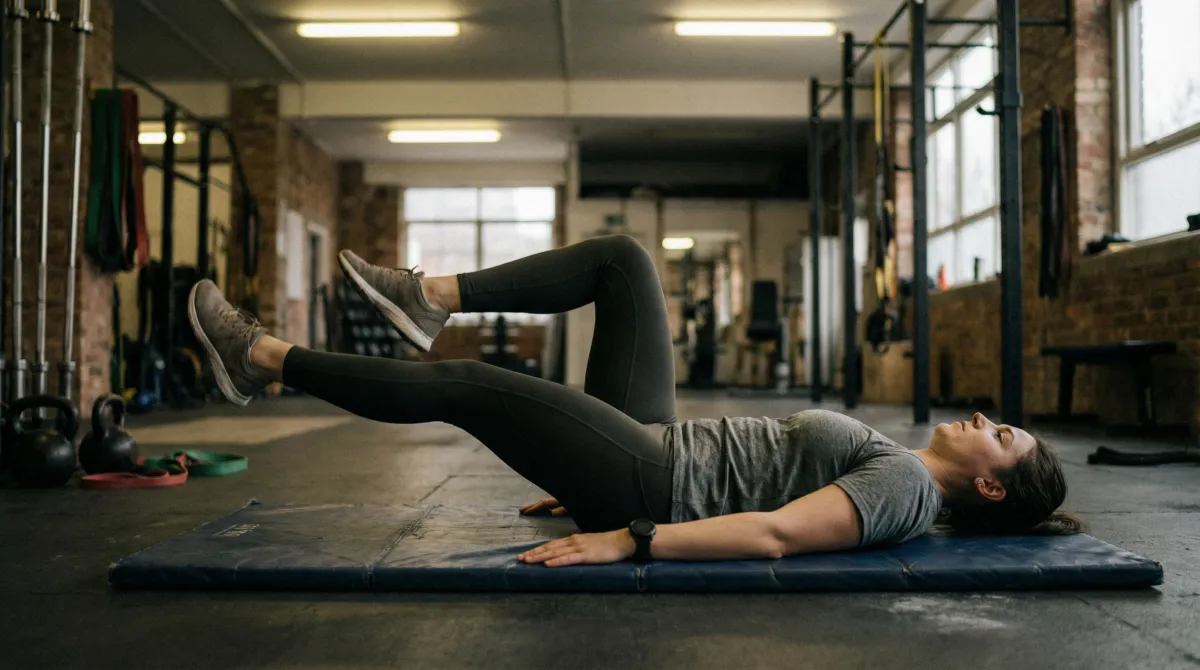
Flutter kicks are a bodyweight core exercise that targets the lower abs, hip flexors, and quads by alternating small, rapid leg movements while lying on your back. They build core endurance, improve hip flexor strength, and develop the anti-extension stability needed for running, cycling, and compound lifts. This guide covers proper form, the most common mistakes, programming recommendations, and progression options for all fitness levels.
Flutter kicks are one of the most commonly prescribed ab exercises in group fitness classes, military PT programs, and swimming dryland training. Despite their popularity, they are also one of the most commonly performed incorrectly. Done right, flutter kicks build serious lower abdominal endurance. Done wrong, they become a hip flexor exercise that aggravates your lower back.
This guide will help you get them right. If you are building a complete core routine, pair flutter kicks with exercises from our exercise library that target the obliques and deep stabilizers for balanced development.
How to do flutter kicks with proper form
Follow these steps for strict form:
- Lie flat on your back on a mat or firm surface. Place your arms at your sides with palms flat on the floor, or tuck your hands under your glutes for additional lower back support.
- Press your lower back into the floor. This is the single most important cue. Engage your core by drawing your belly button toward your spine. You should feel zero gap between your lumbar spine and the ground. Maintain this contact throughout every rep.
- Lift both legs 4 to 6 inches off the ground. Keep your legs straight with a slight soft bend in the knees to reduce hamstring tension. Point your toes.
- Alternate kicking your legs up and down in a controlled, steady rhythm. Each leg should travel about 6 to 12 inches. Think of a swimmer's flutter kick, not a violent thrashing motion. The tempo should be moderate: roughly 1 kick per second per leg.
- Breathe steadily. Do not hold your breath. Exhale in short bursts or maintain a rhythmic breathing pattern throughout the set. Breath-holding increases intra-abdominal pressure and can cause dizziness during longer sets.
Muscles worked by flutter kicks
| Muscle | Role | Engagement Level |
|---|---|---|
| Rectus abdominis (lower portion) | Stabilizes the pelvis against the pull of the legs | Primary |
| Hip flexors (iliopsoas) | Lifts and lowers the legs | Primary |
| Quadriceps | Keeps legs straight during the kick | Secondary |
| Transverse abdominis | Deep core bracing and spinal stability | Secondary |
| Obliques | Anti-rotation stability as legs alternate | Secondary |
The lower abs are notoriously difficult to isolate. Flutter kicks are effective because they challenge the rectus abdominis to stabilize the pelvis in a posterior tilt while the hip flexors move the legs. This is called anti-extension, and it transfers directly to running form, deadlift bracing, and overhead pressing stability.
Want Cora to track this for you?
Try CoraCommon mistakes (and how to fix them)
- Lower back lifts off the floor. This is the most common and most dangerous mistake. When your lower back arches, the load shifts from your abs to your lumbar spine. Fix: Place your hands under your glutes, raise your legs higher (start at 12 inches instead of 4), or bend your knees slightly. If you still cannot maintain a flat back, regress to dead bugs until your core is stronger.
- Kicking too fast. Speed reduces time under tension and increases momentum, both of which reduce the exercise's effectiveness. Fix: Slow down to roughly 1 second per kick. You should feel your abs burning, not your hip flexors cramping.
- Legs too high. Holding your legs at 45 degrees makes the exercise significantly easier because gravity's lever arm is shorter. Fix: Keep your heels 4 to 6 inches from the floor. The lower your legs, the harder your abs work.
- Holding your breath. This causes excessive intra-abdominal pressure and dizziness during longer sets. Fix: Breathe in short, rhythmic exhalations timed to each kick, or use steady nasal breathing.
- Lifting your head and neck. Craning your neck forward creates tension and does not improve ab engagement. Fix: Keep the back of your head on the mat. If you want to add a crunch component, that is a different exercise variation.
Want Cora to help with this?
Try Cora Free Text CoraFlutter kick variations and progressions
Once you have mastered the standard flutter kick, use these variations to increase difficulty or target slightly different muscle groups:
| Variation | Difficulty | What Changes |
|---|---|---|
| Bench flutter kicks | Easier | Hands grip bench edge, easier to maintain flat back |
| Flutter kicks with crunch hold | Harder | Shoulders lifted off ground, upper and lower abs engaged simultaneously |
| Scissor kicks | Similar | Horizontal crossing pattern adds adductor and abductor work |
| Weighted flutter kicks | Harder | Ankle weights (1-5 lb) increase resistance. Only add weight once bodyweight form is flawless. |
| Incline bench flutter kicks | Hardest | Decline angle increases gravitational load on the abs |
How to program flutter kicks into your workouts
Flutter kicks work best as a core finisher at the end of your workout or as part of a core circuit. Here are three ways to use them:
- Timed sets (best for endurance). 3 sets of 20 to 45 seconds with 30 seconds rest. This builds the sustained core endurance needed for running, swimming, and cycling. Start at 20 seconds and add 5 seconds per week.
- Rep-based sets (best for strength focus). 3 sets of 20 to 30 reps (each leg = 1 rep). Use a controlled tempo and focus on feeling the lower abs work. When 30 reps feels easy, lower your legs closer to the floor instead of adding more reps.
- Core circuit (best for complete ab training). Pair flutter kicks with exercises that target different functions: flutter kicks (anti-extension) + pallof press (anti-rotation) + side plank (lateral stability). Perform 30 seconds of each with no rest between exercises, then rest 60 seconds. Repeat 3 rounds.
If you are following a structured training program, Cora can place flutter kicks and other core work at the right point in your session. The AI coaching adjusts core volume based on your Body Charge recovery score, so you do more core work on high-recovery days and less when you need to recover.
Flutter kicks vs other lower ab exercises
How do flutter kicks compare to other popular lower ab exercises?
| Exercise | Lower Ab Activation | Hip Flexor Load | Best For |
|---|---|---|---|
| Flutter kicks | High | Moderate | Endurance, anti-extension stability |
| Reverse crunch | Very high | Low | Isolation, lower ab strength |
| Hanging leg raises | Very high | High | Advanced strength, grip bonus |
| Dead bugs | Moderate | Low | Beginners, rehab, motor control |
Want Cora to help with this?
Try Cora Free Text CoraA well-rounded core program includes exercises from multiple categories. Flutter kicks handle anti-extension endurance; pair them with reverse crunches for lower ab strength and planks or dead bugs for deep stabilization.
Who should avoid flutter kicks?
Flutter kicks are not appropriate for everyone. Avoid them or substitute a regression if:
- You have an active lower back injury or herniated disc. The hip flexor load can compress the lumbar spine.
- You cannot maintain lower back contact with the floor during the entire set. Regress to dead bugs or bent-knee leg raises.
- You experience hip flexor pain or cramping. This usually indicates your hip flexors are doing all the work and your abs are not strong enough to maintain pelvic control. Build core strength with planks and reverse crunches first.
- You are in the late stages of pregnancy. Supine exercises with sustained abdominal pressure are generally contraindicated. Consult your healthcare provider.
Key Takeaways
- Flutter kicks target the lower abs, hip flexors, and quads through rapid alternating leg movements while lying supine.
- The number one rule: keep your lower back pressed flat against the floor. If it arches, raise your legs higher or regress the exercise.
- Program flutter kicks as timed sets (20-45 seconds) or rep-based sets (20-30 per leg), typically as a workout finisher or in a core circuit.
- Progress by lowering your legs closer to the ground, adding a crunch hold, or using light ankle weights once bodyweight form is perfect.
- Pair flutter kicks with reverse crunches and dead bugs for a balanced core routine that covers endurance, strength, and stabilization.
Frequently Asked Questions
What muscles do flutter kicks work?
Flutter kicks primarily target the lower rectus abdominis (lower abs), hip flexors (iliopsoas), and quadriceps. Secondary muscles include the obliques, transverse abdominis (deep core stabilizer), and the anterior tibialis in the shins. Because your legs move independently, flutter kicks also challenge anti-rotation stability, making them a more functional core exercise than static holds alone.
Are flutter kicks good for beginners?
Flutter kicks can work for beginners if performed correctly, but they are not the best starting point for someone with a weak core or lower back pain. Beginners should first master dead bugs and lying leg raises with bent knees before progressing to flutter kicks. The key is keeping your lower back pressed firmly into the floor throughout the movement. If your back arches off the ground, the exercise is too advanced for your current core strength.
How many flutter kicks should I do?
For most people, 3 sets of 20 to 30 kicks (counting each leg as one rep) or 3 sets of 20 to 30 seconds is an effective starting point. Focus on maintaining perfect form rather than hitting a specific number. Once you can complete 3 sets of 30 seconds with your lower back glued to the floor, progress by lowering your legs closer to the ground, adding ankle weights, or increasing the duration to 45 seconds.
What is the difference between flutter kicks and scissor kicks?
Flutter kicks move your legs up and down in a vertical plane with a small range of motion (about 6 to 12 inches). Scissor kicks cross your legs over each other in a horizontal plane, like scissors opening and closing. Both target the lower abs and hip flexors, but scissor kicks place slightly more emphasis on the inner thighs (adductors) and outer hips (abductors). Flutter kicks are generally easier to learn and better for sustained endurance sets.
Track your workouts with Cora
Cora creates AI-powered workout plans that adapt to your recovery, tracks your progress across every metric, and coaches you in real time.