Apple Watch Wrist Temperature: Normal Ranges and What Deviations Mean

Co-Fondatore di Cora (YC W24). Ricercatore di IA e robotica con oltre 500 citazioni da Google Brain e UC Berkeley.
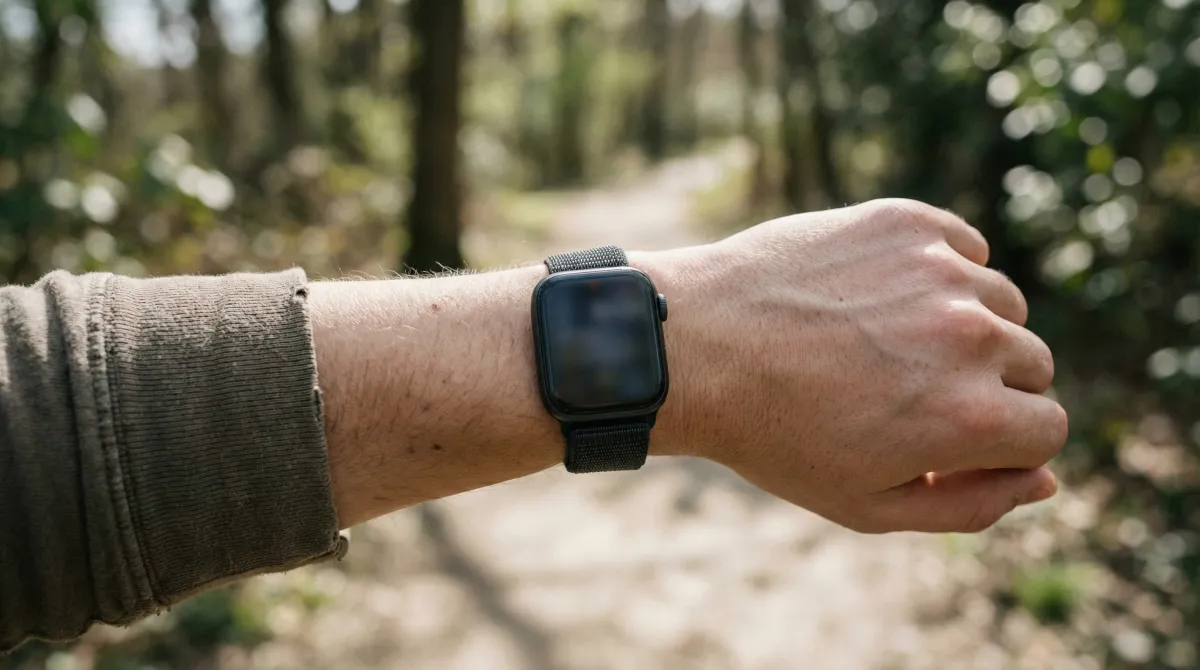
Apple Watch's wrist temperature sensor — available on Series 8, Series 9, Series 10, and Apple Watch Ultra — measures nightly deviation from your personal baseline rather than absolute temperature. A typical baseline is 33–36°C (91–97°F) skin temperature, and normal overnight variation is approximately ±0.5°C from night to night. Deviations beyond ±1°C are clinically meaningful signals worth noting.
Apple Watch introduced wrist temperature sensing in 2022 with the Series 8, making it one of the first mainstream consumer wearables to bring continuous skin temperature monitoring to a mass audience. Unlike continuous core temperature monitoring (which requires invasive methods), wrist skin temperature provides a practical, non-invasive proxy for physiological stress, hormonal changes, and early illness detection.
How Apple Watch Measures Wrist Temperature
The Apple Watch temperature sensor is a two-sensor design: one sensor on the back of the watch (in contact with skin) and one near the face (measuring ambient air temperature). The algorithm subtracts ambient temperature from skin temperature to produce an estimate of true skin temperature uncontaminated by environmental heat. Measurements are taken at approximately 5-minute intervals during sleep to build a nightly average. [Apple Newsroom]
Apple displays this data as a deviation graph — the number of degrees above or below your established personal baseline — rather than as an absolute temperature. This design choice makes the data immediately interpretable (positive or negative deviation from normal) without requiring users to know what their "normal" absolute skin temperature is.
Apple Watch Wrist Temperature Deviation: What Each Range Means
Vuoi che Cora ti aiuti con questo?
Prova Cora Gratis| Deviation from Baseline | Typical Interpretation |
|---|---|
| ±0.0 to ±0.5°C | Normal night-to-night variation. No action needed. |
| +0.5 to +1.0°C | Mild elevation — possible post-exercise, alcohol, illness onset, warm sleep environment, or post-ovulation (if cycling). |
| +1.0 to +1.5°C | Significant elevation — likely illness onset, high training stress, alcohol the prior evening, or progesterone peak (mid-cycle). |
| >+1.5°C | Substantial elevation — strongly suggestive of infection, fever, or acute physiological stress. Monitor alongside RHR and HRV. |
| -0.5 to -1.0°C | Below-baseline temperature — can reflect cold sleep environment, alcohol-induced peripheral vasodilation, or excellent overnight recovery. |
| <-1.0°C | Significantly below baseline — very cold sleep environment or peripheral vasoconstriction. Unusual without environmental explanation. |
Deviation thresholds based on Apple's published temperature sensing documentation and Huang et al. (2021) study in Cell validating smartring temperature sensing for illness detection. Age does not meaningfully affect the deviation interpretation — the personal baseline accounts for individual differences.
Temperature as an Early Illness Indicator
The most clinically validated use of wrist temperature sensing is pre-symptomatic illness detection. A 2021 study published in Cell using Fitbit continuous skin temperature data from 47,000 participants found that a temperature deviation of more than 0.5°C above personal baseline, sustained across multiple nights, preceded confirmed illness by 1–2 days in approximately 75% of cases. [Source]
Vuoi che Cora ti aiuti con questo?
Prova Cora GratisThis is particularly useful for athletes: a temperature spike on a day when you feel fine but have a hard training session planned is a reason to consider reducing intensity or substituting a recovery session. The combination of elevated temperature + elevated RHR + reduced HRV is a high-confidence signal of early illness that is best caught before training compounds the immune stress.
Temperature and the Menstrual Cycle
For Apple Watch users with menstrual cycles, the temperature sensor provides a direct physiological signal of the luteal phase (post-ovulation). The progesterone surge after ovulation causes a sustained body temperature rise of approximately 0.2–0.5°C that persists until menstruation. Apple Watch's Cycle Tracking feature uses this overnight temperature rise to retrospectively estimate when ovulation occurred. This data is available under Health > Cycle Tracking in the iOS Health app and requires at least two full cycles of data for reliable estimation.
What This Means for Your Training
Wrist temperature is a uniquely early warning signal. Unlike HRV or resting heart rate — which can take 2–3 days to show the impact of an emerging illness — temperature elevation often appears in the first night of immune activation. This makes it the metric to watch when you feel "off" but do not yet have obvious symptoms.
The practical protocol: if your Apple Watch shows a temperature deviation of +1°C or more and your resting heart rate is simultaneously elevated by more than 5 bpm above baseline, treat that day as a recovery day regardless of your training schedule. Pushing through early illness typically turns a 2-day setback into a 5-day one. Cora surfaces your wrist temperature deviation alongside your other recovery metrics — HRV, resting heart rate — as a combined readiness signal, making it easy to spot the combination of indicators that warrants backing off before you've derailed your training.
Porta il tuo allenamento al livello successivo con Cora
Cora crea piani di allenamento basati sull'IA che si adattano al tuo recupero, monitora i tuoi progressi su ogni metrica e ti fa da coach in tempo reale.
Prova Cora Gratis