Recovery tracking that actually tells you what to do
Cora's Body Charge score combines your sleep quality, HRV, and resting heart rate into one clear number. Know exactly how recovered you are every morning, and get training recommendations that match.
What is Body Charge?
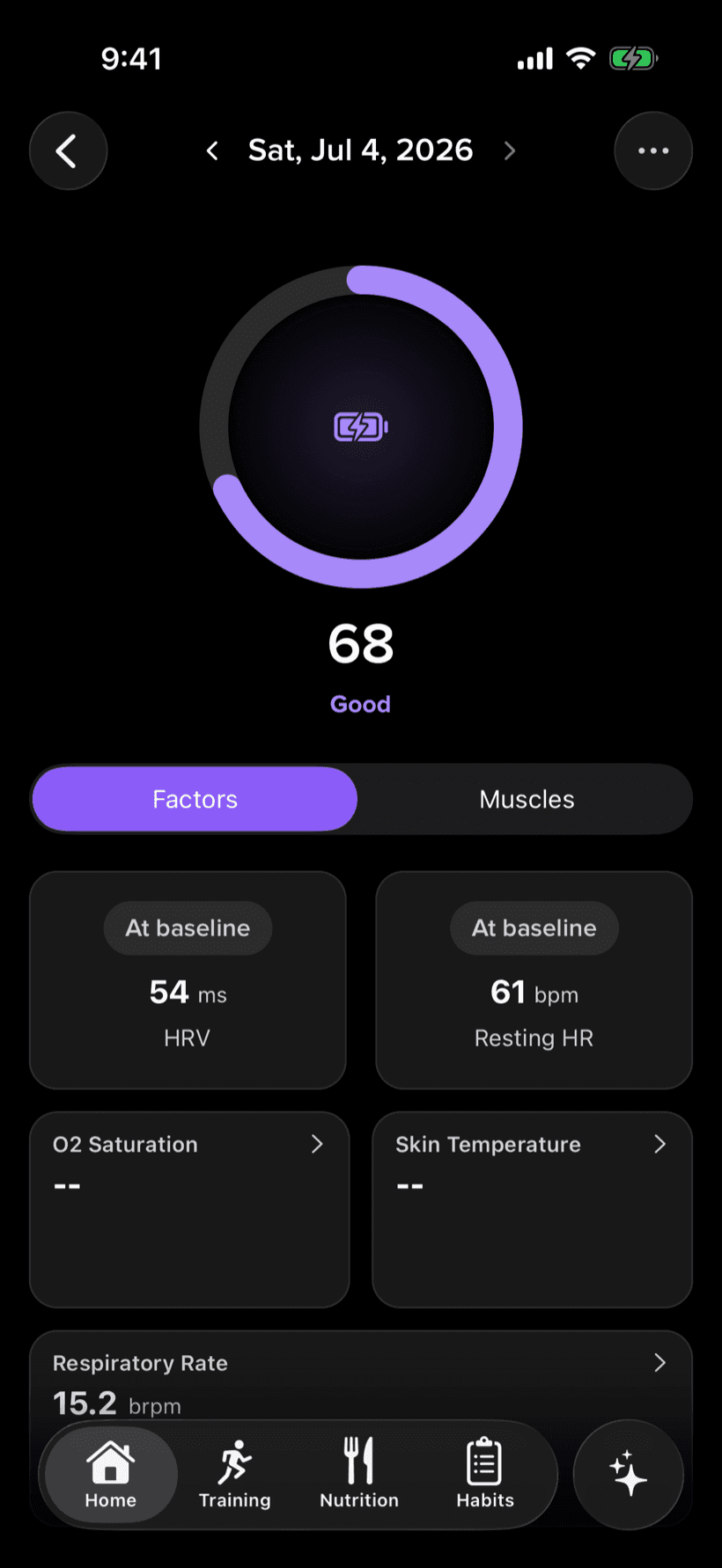
Body Charge is Cora's daily recovery score. It is a single number between 0 and 100 that represents how recovered your body is and how ready you are to take on physical stress. Think of it as your body's battery level for the day.
Most fitness apps give you raw data and leave you to figure out what it means. You see your HRV number, your sleep stages, your resting heart rate, but you have to piece together the full picture yourself. Body Charge does that synthesis for you. It weighs the inputs that matter, accounts for trends over time, and gives you one clear score that answers the question: "How hard should I train today?"
A Body Charge of 80 or above means your body is well-recovered and ready for high-intensity work. Scores in the 50 to 79 range suggest moderate training is appropriate. Below 50, Cora will recommend lighter activity or full rest to help your body catch up. These are not arbitrary thresholds. They are calibrated to your personal baseline and adapt as Cora learns your patterns.
How recovery tracking works in Cora
Every morning, Cora pulls the latest data from your wearable device. It collects three primary inputs: your sleep data (duration, stages, and disturbances), your heart rate variability (HRV), and your resting heart rate. These three signals are the most reliable, research-backed indicators of physical recovery available from consumer wearables.
Cora does not just look at last night's data in isolation. It compares your numbers against your personal rolling baseline. A resting heart rate of 55 bpm might be perfectly normal for one person but elevated for another. By tracking your individual trends over weeks and months, Cora builds a model of what "normal" looks like for you and detects meaningful deviations.
The result is a Body Charge score that reflects your actual physiological state, not a generic estimate. It accounts for training load from previous days, sleep quality trends, and autonomic nervous system balance as measured through HRV. All of this happens automatically in the background. You just wake up, check your score, and know where you stand.
Body Charge 0-100
One number that tells you how recovered you are. Calibrated to your personal baseline, updated every morning from your wearable data.
Sleep Stage Analysis
Deep sleep, REM, light sleep, and awake time all tracked and analyzed. Cora shows you how your sleep quality impacts your recovery over time.
HRV Trends
Heart rate variability tracked daily with trend visualization. See how your autonomic nervous system responds to training, stress, and lifestyle.
Recovery-Adjusted Training
Your workout plan adapts to your Body Charge score every day. High recovery means higher intensity. Low recovery means lighter loads or rest.
HRV explained simply
Heart rate variability, or HRV, measures the variation in time between consecutive heartbeats. Contrary to what most people assume, a healthy heart does not beat like a metronome. There are tiny, natural fluctuations between each beat, and the size of those fluctuations tells you a lot about your body's recovery state.
Higher HRV generally indicates that your body is in a well-recovered, parasympathetic (rest-and-digest) state. Your nervous system has the capacity to handle stress, which means your body is ready for training. Lower HRV suggests your body is still working to recover from previous stress, whether that was a hard workout, poor sleep, illness, or psychological stress.
The key insight is that HRV is most useful as a trend, not as a single data point. Your HRV will naturally fluctuate from day to day. What matters is whether your HRV is trending up, trending down, or holding steady relative to your personal baseline. Cora tracks this trend for you and factors it into your daily Body Charge score, so you do not need to interpret raw HRV numbers yourself.
Sleep and recovery: the non-negotiable foundation
Sleep is the single most powerful recovery intervention available. During slow-wave sleep (N3), pituitary growth hormone release spikes — driving muscle protein synthesis, tissue repair, and immune function. During REM sleep, the brain consolidates motor learning from the day's training, encoding technique improvements into long-term motor programs. Both stages are essential for physical and cognitive adaptation.
The research is unambiguous. A landmark 2011 Stanford study by Mah et al. published in Sleep found that extending sleep to 10 hours in basketball players improved sprint times by 5%, reaction time by 9%, and shooting accuracy by 9%. A 2019 review in the British Journal of Sports Medicine examined 35 studies and concluded that short sleep duration was the most consistent predictor of injury risk in competitive athletes — stronger than training load, sport type, or athlete age.
HRV is the most sensitive indicator of sleep quality's impact on recovery. A single night of sleep below 6 hours is sufficient to suppress morning HRV by 10–20% in trained individuals, consistent with the sympathetic activation caused by elevated cortisol from sleep deprivation. This is why your Body Charge score drops noticeably after poor sleep even when muscle soreness is absent.
How Cora uses recovery data to adjust your training
This is where recovery tracking becomes more than just a number on a screen. Most recovery apps show you a score and then leave you to decide what to do with it. Cora closes that loop. Your Body Charge score directly influences the workout plan that Cora generates for you each day.
When your Body Charge is high, Cora knows your body can handle more. It will program higher-intensity sessions, increase training volume, or schedule a particularly demanding workout that it has been waiting for the right day to assign. When your Body Charge is low, Cora automatically scales back. It might reduce the number of working sets, lower the prescribed intensity, swap in lighter exercise variations, or recommend an active recovery session instead.
This adaptive approach helps you avoid two common training pitfalls. The first is overtraining: pushing through hard sessions when your body is not recovered, which leads to fatigue, injury, and burnout. The second is undertraining: taking it easy on days when your body is fully charged and could benefit from a challenging workout. Cora keeps you in the productive sweet spot between the two.
Why recovery matters for consistency
The biggest predictor of fitness progress is not the intensity of any single workout. It is consistency over weeks, months, and years. And the number one thing that kills consistency is pushing too hard, getting hurt or burned out, and needing to take extended time off.
Recovery tracking helps you stay consistent by keeping your training sustainable. When you train according to your body's actual readiness rather than a fixed schedule, you naturally avoid the boom-and-bust cycle that derails so many training plans. You train hard on the days when your body is ready and back off on the days when it needs rest.
The result is a more even distribution of training stress, fewer forced rest days due to fatigue or injury, and a stronger long-term trajectory of improvement. Whether your goal is building muscle, improving endurance, or losing body fat, recovery-aware training gets you there faster by helping you avoid the setbacks that slow most people down.
Frequently asked questions about fitness recovery
How long does muscle recovery take after a workout?
Muscle recovery takes 24–96 hours depending on training type and intensity. Heavy compound strength training (near-maximal loads) requires 48–96 hours for full muscle recovery and up to 120 hours for CNS recovery. High-intensity interval training (HIIT) requires 48–72 hours. Moderate strength training (8–12 rep range) typically requires 24–48 hours. Steady-state cardio at moderate intensity clears in 12–24 hours. Age, training volume, protein intake, and sleep quality all significantly influence individual recovery timelines.
What is the best way to recover faster from training?
The most evidence-backed recovery accelerators are: adequate sleep (7.5–9 hours with quality slow-wave and REM stages), sufficient protein intake (1.6–2.2g per kg of bodyweight per day, distributed across meals), carbohydrate replenishment within 4 hours post-training, hydration (1.5x the fluid weight lost during training), and appropriate active recovery on low-readiness days. Cold water immersion (10–15°C for 10–15 minutes) has moderate evidence for reducing short-term soreness and perceived fatigue. No supplement meaningfully substitutes for sleep and nutrition.
What does HRV tell you about recovery?
Heart rate variability (HRV) measures the variation in time between successive heartbeats and reflects the balance between your parasympathetic (rest) and sympathetic (stress) nervous systems. High HRV indicates strong parasympathetic tone — your body is recovered and ready for physiological stress. Low HRV signals that your autonomic nervous system is still under load and your body is not fully recovered. HRV measured first thing in the morning before rising provides the most reliable readiness signal, and trending it against your personal 7-day baseline is more informative than any single reading.
How many rest days per week do I need?
Most intermediate athletes benefit from 1–2 complete rest days per week, with additional active recovery days inserted when recovery metrics (HRV, RHR, sleep) indicate below-baseline readiness. Athletes over 40 typically require 2 full rest days and shorter hard training blocks (2–3 weeks of accumulation before a deload, versus 3–5 weeks for younger athletes). The optimal number of rest days varies by training intensity, total weekly volume, sleep quality, and stress from outside training. HRV tracking removes the guesswork.
Track your recovery with precision
Cora synthesizes your HRV, sleep, and resting heart rate into a daily Body Charge score — then automatically adjusts your training plan to match. Connect your wearable and get your first score tomorrow morning.