How to Choose a Fitness Wearable in 2026: The Complete Buyer's Guide

Co-Founder of Cora (YC W24). AI and robotics researcher with 500+ citations from Google Brain and UC Berkeley.
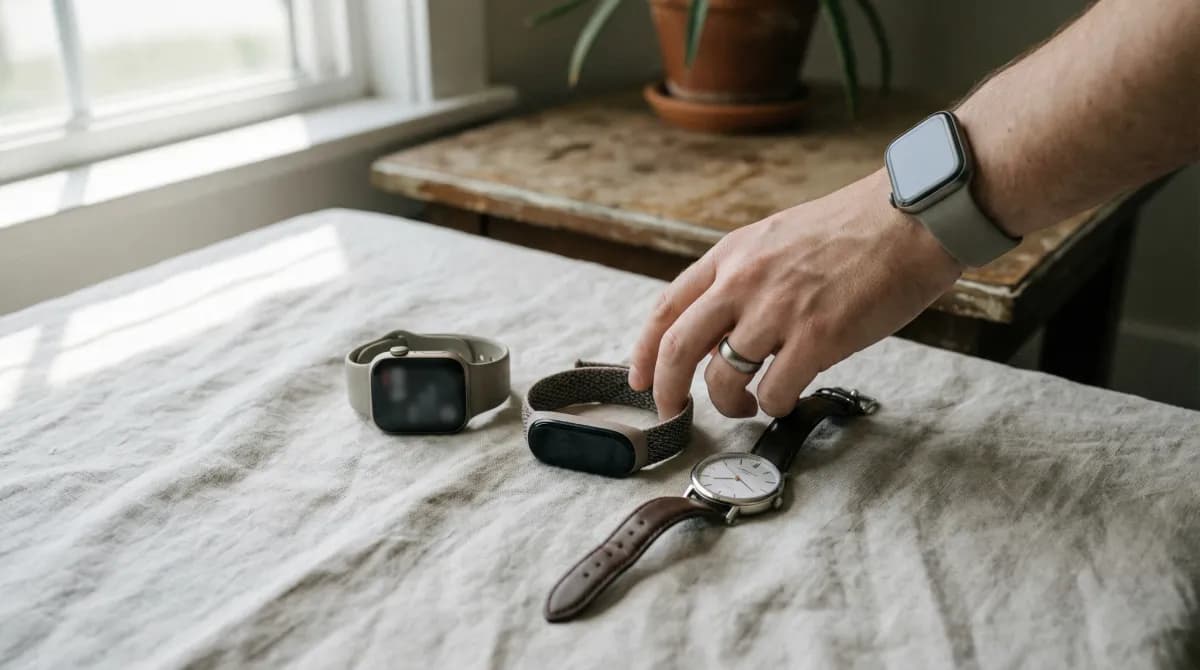
The best fitness wearable depends on your training goals, budget, and which ecosystem you are already in. Apple Watch is the best all-around option for most people due to its sensor accuracy, app ecosystem, and dual-use as a smartwatch. Garmin dominates for endurance athletes who need multi-day battery life. Whoop and Oura are specialist devices for recovery tracking. This guide breaks down what actually matters when choosing a wearable, compares the major options head-to-head, and helps you decide which features are worth paying for.
The fitness wearable market has exploded. There are now over 50 devices from a dozen brands, and every one of them claims to track your health better than the last. Sorting through the noise is genuinely confusing, especially when most review sites are incentivized by affiliate commissions to recommend the most expensive option.
This guide cuts through the marketing. We will cover the 5 factors that actually matter when choosing a wearable, compare the most popular options, and explain which devices work best with recovery and training apps like Cora. If you already own a wearable and are looking for the best app to pair with it, see our best Apple Watch fitness apps guide or Whoop alternatives comparison.
The 5 things that actually matter when choosing a fitness wearable
Ignore the spec sheet arms race. These are the five factors that determine whether a wearable will actually improve your training:
1. Sensor accuracy (especially heart rate and HRV)
Every wearable tracks heart rate, but accuracy varies significantly. Optical wrist-based sensors have improved dramatically, but they still struggle during high-intensity intervals, heavy weightlifting (wrist flexion disrupts the sensor), and cold weather. For most training purposes, the Apple Watch, Garmin, and Whoop are within 2 to 5 BPM of a chest strap during steady-state exercise. For interval training, a chest strap paired via Bluetooth is still more reliable.
HRV accuracy matters most for recovery tracking. Apple Watch measures HRV during sleep using photoplethysmography (PPG), which research published in the Journal of Medical Internet Research has shown to be clinically comparable to ECG-based measurements for RMSSD values during rest. Garmin and Whoop use similar PPG methods. Oura Ring, worn on the finger, benefits from stronger arterial signal and tends to produce slightly more consistent overnight HRV readings.
2. Battery life vs feature trade-offs
Battery life is the single biggest differentiator between wearable categories:
| Device | Battery Life | Has Screen | Trade-off |
|---|---|---|---|
| Apple Watch Series 10 | 18-36 hours | Yes | Daily charging required. Best app ecosystem. |
| Apple Watch Ultra 2 | 36-72 hours | Yes | Larger and heavier. Best Apple option for multi-day tracking. |
| Garmin Forerunner 265 | 13 days | Yes | Limited smartwatch features. Best for runners and cyclists. |
| Garmin Fenix 8 | 16-28 days | Yes | Expensive. Best all-around endurance device. |
| Whoop 4.0 | 4-5 days | No | Screenless. $30/month subscription required. Recovery-focused. |
| Oura Ring Gen 3 | 5-7 days | No | No real-time workout tracking. Best passive sleep and recovery. |
If you need to track sleep and wear the device 24/7, daily charging (Apple Watch) is a limitation. Garmin and Oura excel here. If you primarily want workout tracking and do not mind charging every night, Apple Watch has the richest feature set.
3. Screenless design vs information at a glance
Whoop and Oura are screenless, which makes them more discreet and comfortable for 24/7 wear, especially during sleep. However, the lack of a screen means you cannot see your heart rate, pace, or workout data in real time during training. You need your phone for any mid-workout information.
If real-time feedback during workouts matters to you (heart rate zones, pace alerts, interval timers), you need a device with a screen. Apple Watch and Garmin both deliver this well. If you only care about sleep and recovery data that you review in the morning, a screenless device is perfectly adequate.
4. App ecosystem and data compatibility
The wearable itself is only half the equation. The apps that analyze your data determine how useful the information actually is. Apple Watch has the largest third-party app ecosystem by far: hundreds of fitness apps can read Apple Health data. Garmin has a strong but more closed ecosystem through Garmin Connect. Whoop is entirely self-contained with no third-party app access.
Cora works with Apple Watch, Garmin, Whoop, Oura, and Fitbit through Apple Health and direct integrations. It reads your sleep data, HRV, resting heart rate, and workout history to calculate your Body Charge recovery score and adjust your training load automatically. The more data sources your wearable provides, the more accurate the recovery calculation.
Want Cora to help with this?
Try Cora Free Text Cora5. Comfort and wearability for 24/7 tracking
Recovery and sleep tracking require wearing the device to bed. Comfort matters more than you might think. A heavy watch that irritates your wrist at night will get left on the nightstand, defeating the purpose of owning it.
Oura Ring is the most comfortable option for sleep tracking because you barely notice it. Whoop's fabric band is designed for 24/7 wear and is very lightweight. Apple Watch is comfortable for most people but some find the size annoying during sleep. Garmin varies by model, with lighter models like the Venu series being more sleep-friendly than the bulky Fenix.
Which wearable is best for your goals?
| Your Primary Goal | Best Wearable | Why |
|---|---|---|
| General fitness + smartwatch | Apple Watch Series 10 | Best app ecosystem, accurate sensors, daily use as smartwatch |
| Recovery and sleep tracking | Oura Ring Gen 3 | Most comfortable for 24/7 wear, excellent sleep data |
| Running and endurance sports | Garmin Forerunner 265 or 965 | Multi-day battery, advanced running dynamics, mapping |
| Strength training and gym workouts | Apple Watch + Cora | Workout logging, exercise tracking, recovery-adjusted programming |
| Discreet 24/7 monitoring | Whoop 4.0 or Oura Ring | Screenless, minimal, designed to be invisible |
| Budget-conscious fitness tracking | Apple Watch SE | Same core health sensors as Series 10, lower price |
Want Cora to track this for you?
Try CoraWearable features that matter for habit tracking and consistency
Beyond raw health metrics, some wearable features directly support workout consistency and habit building:
- Activity reminders and move alerts. Apple Watch's Stand and Move reminders nudge you throughout the day. Simple, but effective for building movement habits.
- Streak tracking. Garmin and Apple Watch both track activity streaks. Behavioral research shows that streak visibility increases consistency because people are loss-averse and do not want to break a chain.
- Recovery-based training guidance. Knowing whether today should be a hard day or a rest day removes decision fatigue. Whoop, Garmin Body Battery, and Cora's Body Charge all provide this. This is one of the most undervalued features for long-term consistency because it prevents the boom-and-bust cycle of training too hard and then quitting.
- Social and accountability features. Apple Watch Activity Sharing lets you see friends' rings. Whoop has team leaderboards. Accountability increases consistency by 65% according to the American Society of Training and Development.
What about hot yoga, swimming, and specific activities?
If you have a specific activity that drives your wearable choice:
Want Cora to help with this?
Try Cora Free Text Cora- Hot yoga: Oura Ring or Whoop. Both handle high heat and humidity well. Apple Watch works but the screen can become difficult to use with sweaty wrists, and some hot yoga studios prohibit watches.
- Swimming: Apple Watch (50m water resistance) or Garmin Swim 2. Whoop is also water-resistant. Oura Ring is not recommended for pool swimming due to chlorine degradation of the finish.
- Outdoor running and hiking: Garmin Fenix or Apple Watch Ultra 2 for GPS accuracy and mapping. Standard Apple Watch GPS is adequate for road running but less reliable in dense forest or canyons.
- CrossFit and functional fitness: Apple Watch or Whoop. The key is durability and continuous heart rate during mixed-modality workouts. Garmin works but has a less robust CrossFit-specific app ecosystem.
How to get the most from your wearable
Buying a wearable is the easy part. Getting actionable value from it requires pairing it with the right software. Most people check their step count and close their rings, but the real value lies in recovery tracking, training load management, and long-term trend analysis.
Cora connects to your wearable data (via Apple Health, Garmin Connect, or directly from Whoop) and translates it into daily training recommendations. Instead of just showing you numbers, it tells you what to do with them: train hard today because your recovery is high, scale back because your HRV is trending down, or take a rest day because your training load has been elevated for the past week.
Try our free recovery calculator to see what recovery-based training feels like, or explore all our free fitness tools.
Key Takeaways
- Apple Watch is the best all-around fitness wearable for most people due to its sensor accuracy, app ecosystem, and daily utility as a smartwatch.
- Garmin is the best choice for endurance athletes who need multi-day battery life and advanced running or cycling metrics.
- Whoop and Oura are best for people who prioritize 24/7 recovery and sleep tracking over real-time workout data.
- The five factors that matter most are sensor accuracy, battery life, screen vs screenless design, app ecosystem compatibility, and comfort for 24/7 wear.
- The wearable is only as useful as the software analyzing its data. Pairing your device with a recovery and training app like Cora turns raw metrics into actionable daily guidance.
Frequently Asked Questions
What is the best fitness wearable for tracking recovery?
For recovery tracking, the Apple Watch Series 10 or Ultra 2 paired with a recovery app like Cora offers the best combination of sensor accuracy, battery life, and actionable insights. Apple Watch tracks HRV, resting heart rate, sleep stages, blood oxygen, and skin temperature, which are the core inputs for recovery scoring. Garmin Fenix and Forerunner watches also excel at recovery with their Body Battery metric. Whoop provides dedicated recovery tracking but requires a separate subscription and device. Oura Ring tracks recovery passively with excellent sleep data but lacks real-time workout tracking.
Do I need a wearable to track my fitness?
You do not strictly need a wearable, but you are missing significant data without one. A wearable provides objective metrics like heart rate variability, resting heart rate, sleep quality, and training load that are impossible to track manually. These metrics help you understand when to push harder and when to recover. You can still make progress without a wearable by listening to your body, tracking your workouts manually, and following a structured program. However, data-driven training is consistently more effective for avoiding overtraining and staying consistent long-term.
Apple Watch vs Garmin vs Whoop: which should I choose?
Choose Apple Watch if you want an all-purpose smartwatch that also does fitness tracking, especially if you already have an iPhone. Choose Garmin if you are a serious endurance athlete who needs multi-day battery life, advanced running and cycling metrics, and mapping. Choose Whoop if you are exclusively interested in recovery and strain data and do not mind paying a monthly subscription for a screenless device. For most people who want both a smartwatch and serious fitness tracking, the Apple Watch paired with a recovery app like Cora provides the best value.
What should I look for when choosing a wearable for training load tracking?
For training load tracking, prioritize a wearable with continuous heart rate monitoring, GPS for outdoor activities, and compatibility with a training load analysis app. Apple Watch, Garmin, and Whoop all track training load natively or through companion apps. Key metrics to look for include acute training load (recent 7-day strain), chronic training load (28-day rolling average), and the acute-to-chronic ratio which helps predict injury risk. Cora calculates all of these metrics from Apple Watch, Garmin, or Whoop data and adjusts your training plan accordingly.
Track your fitness data with Cora
Cora creates AI-powered workout plans that adapt to your recovery, tracks your progress across every metric, and coaches you in real time.