What's a Good One Rep Max? Bench, Squat & Deadlift Standards

Co-Founder of Cora (YC W24). AI and robotics researcher with 500+ citations from Google Brain and UC Berkeley.
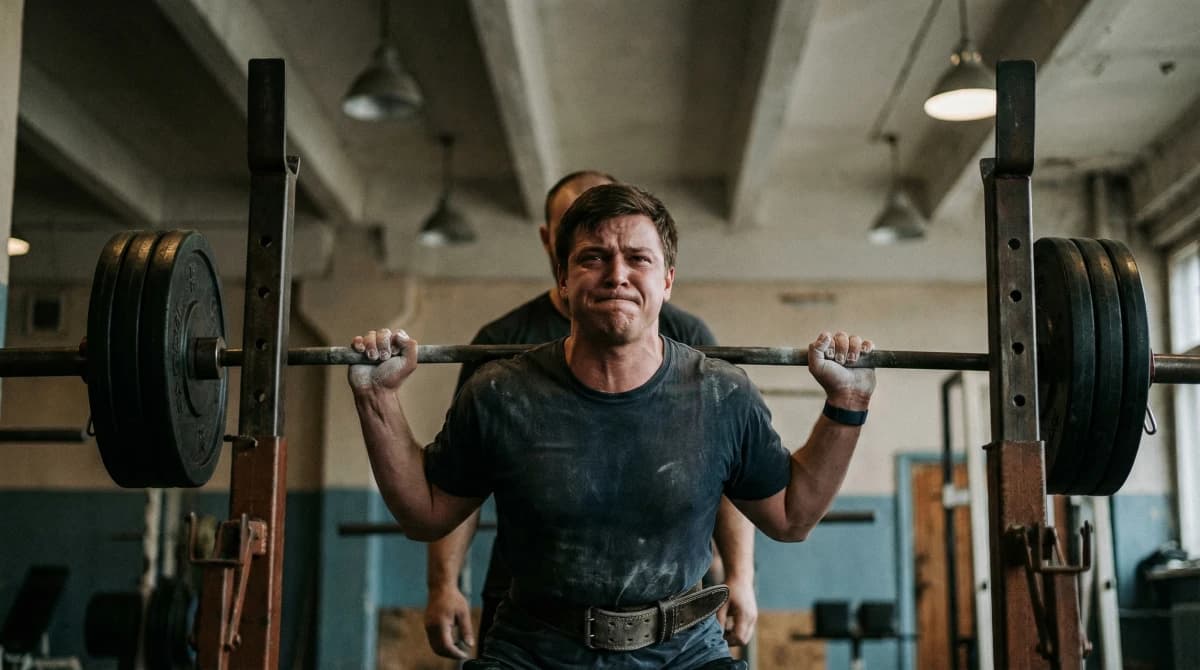
A good one rep max depends on your body weight, sex, training age, and the specific lift. For men, reaching a 1.5× bodyweight squat, 1.25× bodyweight bench press, and 2× bodyweight deadlift marks the transition from novice to intermediate strength. For women, the equivalent milestones are roughly 1.0× BW squat, 0.75× BW bench press, and 1.5× BW deadlift. These standards are widely used in powerlifting and sports science as practical benchmarks for assessing general strength level. You can calculate your estimated 1RM for any lift with our free 1RM calculator.
Whether you are just starting out or have been training for years, knowing where your lifts stand relative to evidence-based strength standards helps you set realistic goals and measure progress. This guide covers 1RM benchmarks for the three major barbell lifts — bench press, squat, and deadlift — broken down by experience level, body weight, and sex.
What counts as a "good" one rep max?
Strength standards are relative. A 315 lb bench press is elite for a 165 lb natural lifter but unremarkable for a 242 lb powerlifter. The most useful way to compare strength across body sizes is to express your 1RM as a ratio of your body weight — commonly called a strength-to-weight ratio or relative strength ratio.
The four experience tiers most commonly used in strength standards literature are:
- Novice: Less than 6 months of consistent barbell training. Still making rapid week-to-week progress.
- Intermediate: 6 months to 2 years of consistent training. Progress is measured in weeks to months, not sessions.
- Advanced: 2–5+ years of consistent, structured training. Progress is slow and requires periodization.
- Elite: Top percentile of competitive lifters. Often requires genetic advantages and years of dedicated training.
Bench press 1RM standards by experience level
The bench press is the most commonly tested upper body strength exercise. Standards below are expressed as a ratio of body weight for men and women at each experience level.
Bench press 1RM by body weight ratio — Men
| Experience level | 1RM ratio (× BW) | Example: 180 lb lifter |
|---|---|---|
| Novice | 0.75× | 135 lbs |
| Intermediate | 1.0–1.25× | 180–225 lbs |
| Advanced | 1.5–1.75× | 270–315 lbs |
| Elite | 2.0×+ | 360+ lbs |
Bench press 1RM by body weight ratio — Women
| Experience level | 1RM ratio (× BW) | Example: 140 lb lifter |
|---|---|---|
| Novice | 0.5× | 70 lbs |
| Intermediate | 0.65–0.85× | 91–119 lbs |
| Advanced | 1.0–1.2× | 140–168 lbs |
| Elite | 1.4×+ | 196+ lbs |
Squat 1RM standards by experience level
The back squat is the most direct measure of lower body and whole-body strength. It requires more technical development than the deadlift, so novice standards are somewhat lower relative to body weight.
Back squat 1RM by body weight ratio — Men
| Experience level | 1RM ratio (× BW) | Example: 180 lb lifter |
|---|---|---|
| Novice | 1.0× | 180 lbs |
| Intermediate | 1.5× | 270 lbs |
| Advanced | 2.0× | 360 lbs |
| Elite | 2.5×+ | 450+ lbs |
Back squat 1RM by body weight ratio — Women
Want Cora to help with this?
Try Cora Free Text Cora| Experience level | 1RM ratio (× BW) | Example: 140 lb lifter |
|---|---|---|
| Novice | 0.75× | 105 lbs |
| Intermediate | 1.0–1.2× | 140–168 lbs |
| Advanced | 1.5–1.75× | 210–245 lbs |
| Elite | 2.0×+ | 280+ lbs |
Deadlift 1RM standards by experience level
The deadlift typically allows the highest absolute loads of any barbell lift and is often the last of the three powerlifts to plateau. Because it recruits more total muscle mass than the squat or bench press, strength-to-weight ratios are higher across all experience levels.
Deadlift 1RM by body weight ratio — Men
| Experience level | 1RM ratio (× BW) | Example: 180 lb lifter |
|---|---|---|
| Novice | 1.25× | 225 lbs |
| Intermediate | 1.75–2.0× | 315–360 lbs |
| Advanced | 2.25–2.5× | 405–450 lbs |
| Elite | 3.0×+ | 540+ lbs |
Deadlift 1RM by body weight ratio — Women
| Experience level | 1RM ratio (× BW) | Example: 140 lb lifter |
|---|---|---|
| Novice | 0.75–1.0× | 105–140 lbs |
| Intermediate | 1.2–1.5× | 168–210 lbs |
| Advanced | 1.75–2.0× | 245–280 lbs |
| Elite | 2.25×+ | 315+ lbs |
Overhead press 1RM standards by experience level
The standing barbell overhead press (OHP) is widely used as a secondary upper body strength indicator. Because it is mechanically less efficient than the bench press and requires more shoulder mobility and core stability, absolute loads are lower. OHP standards also vary more between individuals than the other three main barbell lifts due to differences in shoulder anatomy and proportional arm length.
Overhead press 1RM by body weight ratio — Men
| Experience level | 1RM ratio (× BW) | Example: 180 lb lifter |
|---|---|---|
| Novice | 0.5× | 90 lbs |
| Intermediate | 0.65–0.75× | 117–135 lbs |
| Advanced | 1.0–1.1× | 180–198 lbs |
| Elite | 1.3×+ | 234+ lbs |
Overhead press 1RM by body weight ratio — Women
Want Cora to help with this?
Try Cora Free Text Cora| Experience level | 1RM ratio (× BW) | Example: 140 lb lifter |
|---|---|---|
| Novice | 0.3× | 42 lbs |
| Intermediate | 0.4–0.55× | 56–77 lbs |
| Advanced | 0.65–0.8× | 91–112 lbs |
| Elite | 0.9×+ | 126+ lbs |
How do strength standards change with age?
The 1RM standards above are most applicable to adults in the 20–40 age range, where strength typically peaks. After age 40, absolute strength begins a gradual decline — roughly 1–2% per year for untrained individuals and significantly less for those who maintain structured training. Research published in the Journal of Strength and Conditioning Research consistently shows that masters athletes (40+) can maintain near-peak strength with consistent resistance training, though recovery between sessions may take longer.
A practical adjustment: for lifters over 50, set your target in the lower half of each experience band rather than the upper half. A 55-year-old male who intermediate-squats 1.35× bodyweight is performing comparably to a 30-year-old at 1.5×, when age-related physiological changes are accounted for. Absolute numbers matter less than the trend direction — are you stronger than you were six months ago?
How to estimate your 1RM without maxing out
Testing a true 1RM carries meaningful injury risk, especially for beginners and when form degrades under maximal load. A safer and equally informative approach is to perform a near-maximal set of 3–5 reps and use a validated formula to predict your 1RM. The Epley, Brzycki, and Lombardi formulas all produce reliable estimates from submaximal sets, and using the average of all three reduces formula-specific bias. These formulas are consistent with strength assessment protocols described in NSCA (National Strength and Conditioning Association) guidelines.
Use our free 1RM calculator to enter your working weight and reps and get an estimated 1RM instantly, along with a full training percentage chart showing what you should be lifting at each intensity zone.
How to improve your 1RM across all lifts
Moving from one experience tier to the next requires a different approach depending on where you are starting. For novices, simply adding weight to the bar each session (linear progression) produces rapid 1RM gains — a beginner can often add 5–10 lbs per week to their squat and deadlift and 2.5–5 lbs to their bench and overhead press for months at a time. This phase should not be complicated with elaborate programming.
At the intermediate level, weekly progression replaces session-to-session progression. Programs like 5/3/1, the Texas Method, and GZCLP all use a weekly undulating intensity structure that keeps the lifter progressing while managing fatigue. The key variable is weekly volume: research by Krieger (2010) and others consistently shows that 10–20 hard sets per muscle group per week outperforms lower volumes for strength gains in intermediate lifters.
For advanced lifters, 1RM progress is measured in months and requires periodization — deliberately cycling intensity and volume over 8–16 week blocks to peak at the right time. Competition powerlifters typically run a hypertrophy-focused block (higher volume, 70–80% 1RM), followed by a strength block (lower volume, 80–90%), then a peaking block (very low volume, 90%+) before retesting. Even recreational lifters benefit from this structure once linear and weekly progression stalls. For a detailed breakdown of how to structure your training for consistent strength gains over time, read our guide on progressive overload.
Using strength standards to set realistic goals
Strength standards work best as directional milestones, not rigid pass/fail benchmarks. Individual variation in limb length, muscle fiber composition, training history, and body composition means that some people will hit advanced standards quickly while others plateau at intermediate for years despite consistent training. Neither outcome is a failure — it reflects genetic reality.
A more useful framing: track your 1RM trend over time. If your squat goes from 1.0× to 1.3× bodyweight over 12 months of consistent training, that is meaningful progress regardless of where you land on any external standard. Consistent progressive overload, tracked nutrition, and adequate recovery are the variables you can control. The standards just give you a map.
Take your training further with Cora
Cora creates AI-powered workout plans that adapt to your recovery, tracks your progress across every metric, and coaches you in real time.